English
 Español
 русский
 日本語
日本語
 عربى
عربى


Content
The Definitive Answer: Choosing the Right Fishing Magnet
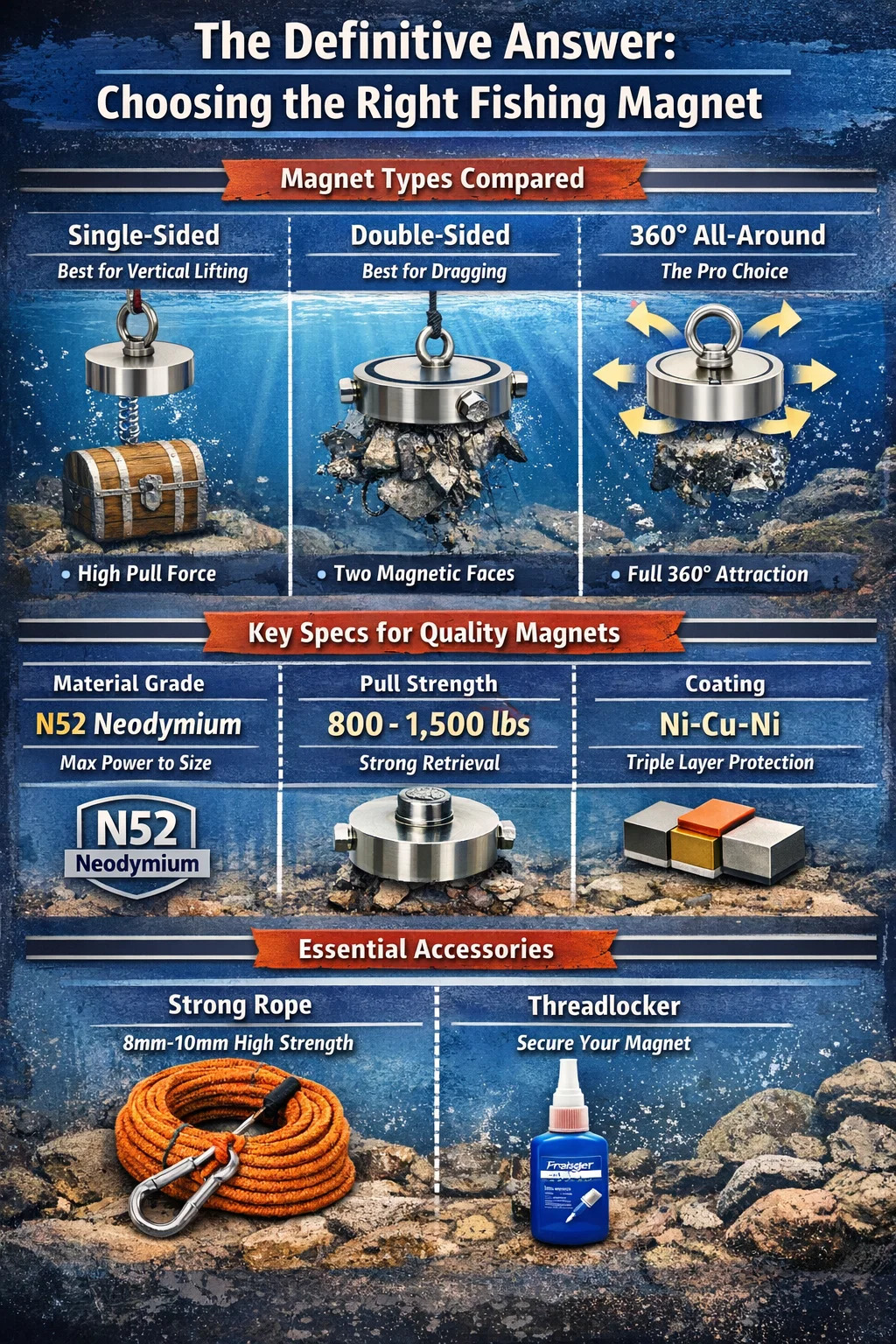
The 360-degree Neodymium magnet is widely considered the best choice for serious enthusiasts because it offers magnetic pull from every angle, significantly increasing the chances of a catch. For beginners, a double-sided fishing magnet provides the best balance between cost, weight, and effectiveness. The core material must always be Neodymium (NdFeB), specifically N52 grade, as it provides the highest power-to-size ratio available in modern technology.
Comparing Magnet Types for Different Environments
Selecting the right tool depends heavily on where you are searching and what you hope to find. Not every fishing magnet is built for the same task.
Single-Sided Magnets: Best for Vertical Lifting
These magnets have one flat magnetic face protected by a steel cup. They are perfect for dropping straight down from bridges or piers. Since all the magnetic flux is concentrated on one side, they often boast higher "combined" pull strengths, such as 1,200 lbs or more, focused on a single point.
Double-Sided Magnets: Best for Dragging
If you are throwing your fishing magnet into a river and dragging it back to the bank, a double-sided model is superior. It features two magnetic faces, meaning it doesn't matter which side lands face-down on the riverbed; it will still grab onto metallic debris as it slides along the bottom.
360-Degree "All-Around" Magnets: The Professional Choice
These are the newest evolution in the hobby. Unlike the cupped versions, these are solid blocks of Neodymium. They pull from the top, bottom, and sides. While they are more fragile and expensive, their "catch rate" is nearly double that of traditional designs in rocky or trash-heavy waters.
Key Performance Factors and Specifications
When shopping, look past the marketing fluff and focus on the technical specs that actually dictate how your fishing magnet will perform in murky water.
| Magnet Feature | Ideal Range/Spec | Why It Matters |
|---|---|---|
| Material Grade | N52 Neodymium | Highest magnetic saturation point |
| Pull Strength | 800 lbs - 1,500 lbs | Necessary to fight current and mud |
| Coating | Ni-Cu-Ni (Triple Layer) | Prevents corrosion in freshwater |
Understanding Pull Strength vs. Real-World Weight
A common mistake is assuming a 1,000 lb fishing magnet can easily lift a 1,000 lb object. Pull strength is measured under perfect laboratory conditions—flat, clean, thick steel. In the wild, you deal with rust, uneven surfaces, and silt.
- The Rust Factor: Thick rust can reduce a magnet's effective grip by 70% or more.
- Surface Area: A magnet can only pull its full weight if the entire face is in contact with the metal. Round objects like pipes are harder to catch.
- Leverage: As you pull an item through the water, the resistance of the water acts as a lever that tries to peel the fishing magnet off the object.
Critical Accessories to Pair with Your Magnet
Even the best magnet is useless if the secondary gear fails. You need a setup that complements the power of your fishing magnet.
The Importance of High-Grade Rope
Don't use cheap clothesline. You need 8mm to 10mm static climbing rope or specialized paracord with a breaking strength that exceeds your magnet's pull rating. If your magnet gets stuck, you may need to use a winch or several people to pull it free; a weak rope will snap, leaving your expensive gear at the bottom of the lake.
Threadlocker (Glue)
Vibrations and dragging will unscrew the eyelet from your fishing magnet over time. Using a medium-strength threadlocker (like Blue Loctite) is mandatory. Apply it to the threads of the bolt before your first outing to ensure the magnet stays attached to the rope.
Final Verdict for Beginners and Pros
If you are just starting out, go for a double-sided fishing magnet kit with a pull rating of around 1,200 lbs (combined). This gives you roughly 600 lbs of force per side, which is enough to pull up bikes and tools without being so heavy that it becomes a chore to throw. For those looking to maximize their finds in deep silt, the 360-degree beast is the undisputed king of the riverbed.