English
 Español
 русский
 日本語
日本語
 عربى
عربى


Content
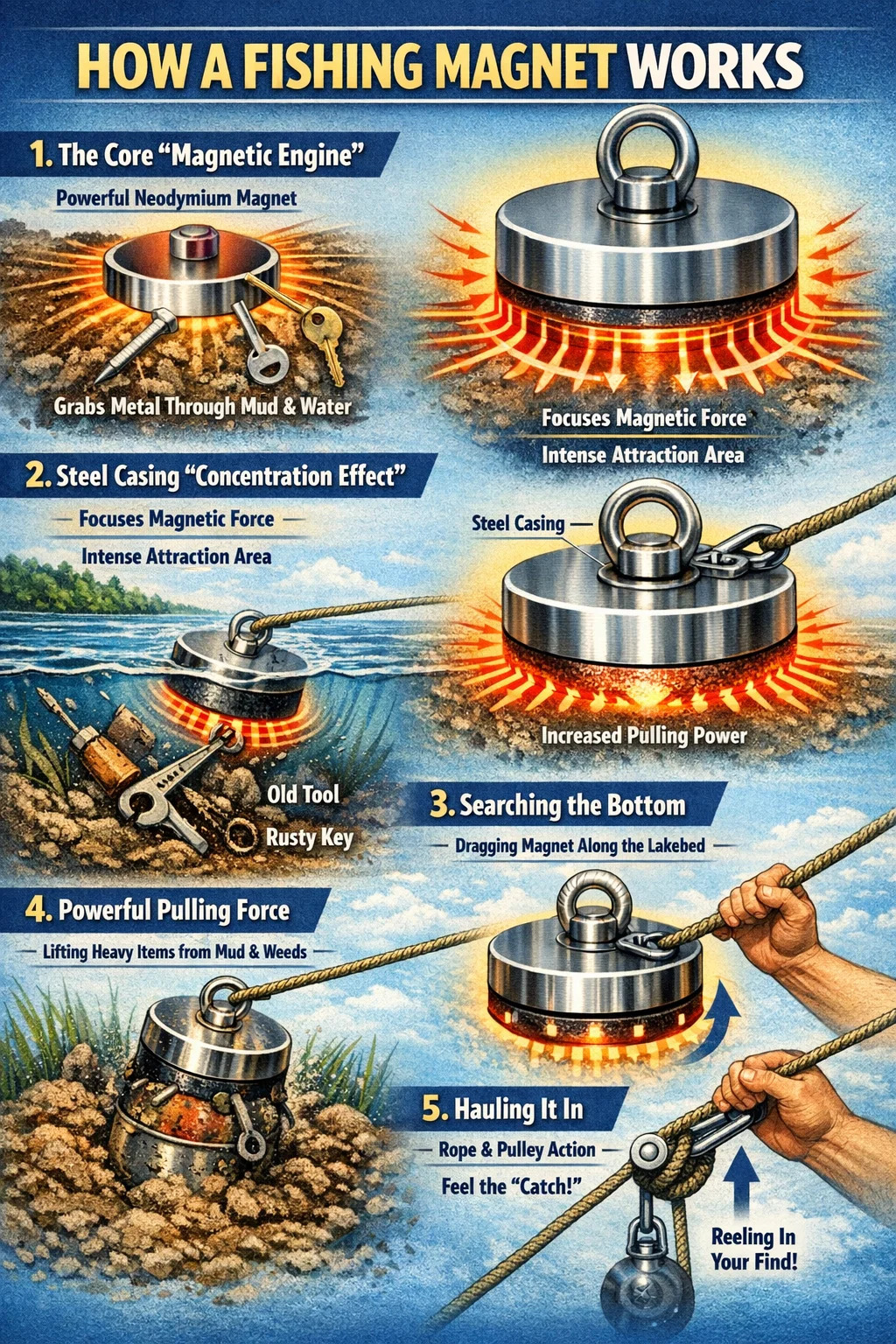
To understand how a fishing magnet works, you can imagine it as a super-powered "underwater vacuum cleaner," except instead of dust, it sucks up metal.
Here's an explanation of how it works:
1. The Core "Magnetic Engine"
The heart of a fishing magnet is a high-performance magnetic core. It's usually made of a special alloy material that generates a magnetic field hundreds or thousands of times stronger than a regular refrigerator magnet.
Invisible Grip: Even at a distance or through thick mud and sand, this magnetic field acts like a pair of invisible hands, quickly grabbing iron-containing objects at the bottom of the water.
2. The Steel Casing's "Concentration Effect"
If you look closely, you'll see that the magnet is encased in a sturdy metal shell. This isn't just for aesthetics or protection:
Magnetic Force Concentration: The steel casing is carefully designed to prevent magnetic force from spreading sideways, forcing all the magnetic force to be directed to the bottom surface of the magnet.
Doubled Efficiency: This makes the "stickiness" of the magnet's bottom incredibly strong, ensuring that once it touches a target, it holds on tightly.
3. Finding and Capturing the Target
When you tie a rope to the fishing magnet and throw it into the water, it begins a "blind search" process:
Large-Area Search: As you drag the rope from the shore, the magnet slides or bounces along the bottom of the water.
Instant Adhesion: As soon as it passes over an iron object (such as old tools, iron buckets, or dropped keys), the magnetic field instantly overcomes gravity and water resistance, "sucking" the object onto the magnet's surface.
4. Pulling Force to Overcome Environmental Resistance
The conditions at the bottom of the water are often complex; metal objects may be entangled in weeds or deeply buried in mud.
Powerful Drag: This is why fishing magnets need extremely strong suction. They must have enough power to forcefully pull out heavy objects stuck in the mud. Secure Connection: As long as the metal surface is in contact with the magnet, this molecular-level attraction ensures that the object won't easily fall back into the water while you're pulling it out.
5. Simple Mechanical Transmission
The entire process ultimately relies on the strength of the rope in your hands and the power of your arms:
Leverage and Pulley System: The magnet acts as a medium, converting the mechanical force you apply to the rope into a vertical or horizontal pulling force on the target at the bottom of the water.
Physical Feedback: When the magnet latches onto a large object, you will feel a distinct "heaviness" or "impact" through the rope, indicating that the fishing magnet has successfully hooked the object.