English
 Español
 русский
 日本語
日本語
 عربى
عربى


Content
- 1 What Magnet Do You Actually Need for Magnet Fishing?
- 2 Understanding Pull Force: The Number That Changes Everything
- 3 Single-Sided vs. Double-Sided Fishing Magnets
- 4 Why Neodymium Is the Only Magnet Type Worth Using
- 5 Rope Selection: The Part Most Beginners Get Wrong
- 6 Magnet Size and Diameter: Finding the Right Footprint
- 7 Top Fishing Magnet Brands and Models Worth Considering
- 8 Essential Accessories That Maximize Your Magnet Fishing Results
- 9 Best Locations to Use a Fishing Magnet
- 10 Casting Techniques That Improve Your Find Rate
- 11 Safety Rules Every Magnet Fisher Must Follow
- 12 Legal Considerations for Magnet Fishing
- 13 How to Maintain and Store Your Fishing Magnet
What Magnet Do You Actually Need for Magnet Fishing?
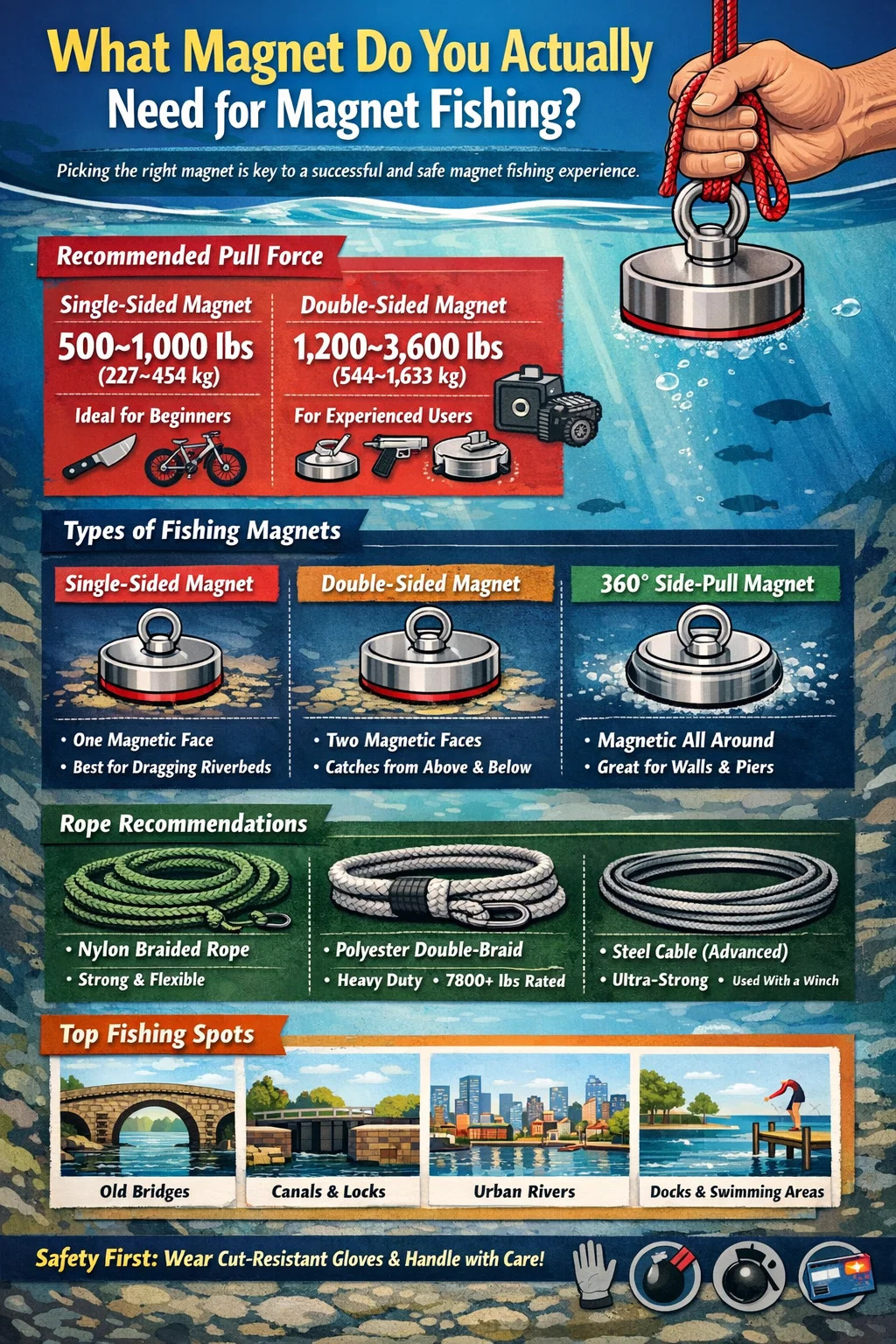
The short answer: for most beginners, a single-sided neodymium magnet with 500–1,000 lbs (227–454 kg) of pull force is the ideal starting point for magnet fishing. It is strong enough to retrieve knives, tools, bikes, and even safes from rivers and lakes, yet manageable enough to handle safely without specialized equipment. If you are more experienced or targeting heavier objects in deep water, a double-sided magnet in the 1,200–3,600 lb range becomes the better choice.
Magnet fishing has grown from a niche hobby into a mainstream outdoor activity practiced by hundreds of thousands of people worldwide. The gear you choose — specifically the fishing magnet itself — determines not only what you find, but also how safely and efficiently you can operate. This guide breaks down every factor that matters when selecting a magnet for magnet fishing, from pull force ratings and magnet geometry to rope attachments and legal considerations.
Understanding Pull Force: The Number That Changes Everything
Pull force is the single most discussed specification when choosing a fishing magnet. It refers to the maximum vertical force required to detach the magnet from a flat, smooth steel surface under ideal laboratory conditions. In real-world magnet fishing, the effective pull is almost always lower because underwater surfaces are rusted, coated in sediment, angled awkwardly, or only partially in contact with the magnet face.
A rule of thumb used widely in the magnet fishing community is to expect roughly 20–40% of the rated pull force in practical field conditions. So a magnet advertised at 1,000 lbs of pull will realistically retrieve objects weighing up to 200–400 lbs when accounting for water resistance, rope angle, and surface contact area.
Pull Force Ranges and What They Recover
| Pull Force Rating | Typical User Level | Common Finds |
|---|---|---|
| 200–400 lbs (90–181 kg) | Kids / Casual beginners | Coins, bolts, small tools, fishing hooks |
| 500–1,000 lbs (227–454 kg) | Beginners / Intermediate | Knives, anchors, bike frames, scooters |
| 1,200–2,000 lbs (544–907 kg) | Intermediate / Advanced | Guns, safes, motorcycle parts, large chains |
| 2,500–3,600 lbs (1,134–1,633 kg) | Advanced / Professional | Engine blocks, large safes, vehicle axles |
One important caveat: bigger is not always better. Extremely powerful magnets — anything above 2,000 lbs — can snap ropes, are nearly impossible to separate from steel surfaces without a wedge tool, and pose genuine injury risks if they pinch fingers. New magnet fishers who jump straight to a 3,000 lb magnet often end up frustrated or hurt. Build up gradually.
Single-Sided vs. Double-Sided Fishing Magnets
Magnet fishing magnets come in two primary configurations, and understanding the difference is essential before you buy.
Single-Sided Magnets
A single-sided magnet has one active magnetic face on the bottom and a threaded eyebolt on top for rope attachment. The magnetic field is concentrated entirely on that one face, which means all of the pull force is directed downward. This design is excellent for dragging along riverbeds, throwing into canals and pulling back along the bottom, and working from bridges where the magnet needs to descend vertically. Single-sided magnets are the most popular choice among magnet fishers globally, and for good reason: they are straightforward, reliable, and easy to handle.
Double-Sided Magnets
A double-sided magnet — sometimes called a two-sided or 360-degree magnet — has active magnetic faces on both the top and the bottom, with the rope attachment point in the middle. This configuration catches objects from above and below simultaneously and performs especially well when lowered vertically into deep water or dropped from a boat. The trade-off is that the pull force on each individual face is somewhat lower than an equivalent-weight single-sided magnet, and the handling is more complex. Double-sided magnets are best suited to vertical drops in still or slow-moving water rather than horizontal dragging along a riverbed.
360-Degree Side-Pull Magnets
A newer design gaining popularity is the 360-degree side-pull magnet, which has a rope attachment at the top and a magnetic surface that wraps around the sides of the magnet body rather than concentrating on one flat face. This type is particularly effective for pulling along seawalls, dock pilings, and any vertical metal structure where a flat-face magnet would barely make contact. It is a specialist tool rather than an everyday first purchase, but serious magnet fishers often add one to their kit.
Why Neodymium Is the Only Magnet Type Worth Using
If you have ever seen a ferrite or ceramic magnet in a hardware store, you know they are big, heavy, and relatively weak. Neodymium magnets — made from an alloy of neodymium, iron, and boron — are the polar opposite: extraordinarily strong relative to their size, compact enough to fit in a jacket pocket, and capable of holding onto objects many times their own weight.
Neodymium magnets are rated by grade, with common grades for magnet fishing including N42, N52, and N55. The number refers to the maximum energy product of the material, which correlates directly with magnetic strength. N52 is currently the most widely used grade in fishing magnets because it offers an excellent balance of strength, cost, and structural integrity. N55 magnets are stronger but considerably more expensive and more brittle, making them prone to chipping if they slam into hard objects underwater — which happens constantly in real-world use.
All quality fishing magnets are encased in a nickel-copper-nickel (Ni-Cu-Ni) coating inside a steel cup or pot casing. This outer casing serves two critical functions: it focuses the magnetic flux through the face of the magnet to dramatically increase pull force, and it protects the brittle neodymium core from physical damage. A bare neodymium magnet has a fraction of the practical pull force of the same magnet in a steel pot casing.
Rope Selection: The Part Most Beginners Get Wrong
The magnet gets all the attention, but the rope is just as critical. A 1,000 lb magnet attached to a 300 lb-rated paracord will snap under load and send your expensive magnet to the riverbed permanently. The rope must be rated to handle forces well above the magnet's pull force, with a significant safety margin.
Recommended Rope Types for Magnet Fishing
- Nylon braided rope: The most popular choice. Nylon absorbs shock loads, resists abrasion, and maintains flexibility in cold water. A 3/8-inch (9.5 mm) nylon rope has a working load of around 1,300 lbs and a break strength of over 5,000 lbs — appropriate for magnets up to about 1,500 lbs pull force.
- Paracord (550 cord): Acceptable only for very light magnets under 400 lbs. The 550 lb break strength provides minimal safety margin and paracord stretches significantly, reducing control.
- Polyester double-braid rope: Excellent for high-pull applications. Low stretch, high strength, and good UV resistance. A half-inch polyester double-braid rope breaks at around 7,800 lbs, making it a safe choice even for the largest fishing magnets on the market.
- Steel cable or wire rope: Used by some serious magnet fishers who routinely pull very heavy objects. Steel cable does not stretch and is nearly impossible to cut, but it is heavy, inflexible, and requires a winch or pulley for large retrieval operations.
A minimum rope length of 65 feet (20 meters) is recommended for bridge fishing. For open riverbank or canal dragging, 30–40 feet is often sufficient. Always tie using a proper knot — the double figure-eight follow-through knot is the standard among magnet fishers because it is easy to inspect visually and retains close to 100% of the rope's rated strength even after heavy loads.
Magnet Size and Diameter: Finding the Right Footprint
The diameter of the magnet face determines how large an area it can make contact with in a single pass. A larger face picks up smaller objects more reliably and maintains better contact with uneven or corroded surfaces. However, large-diameter magnets are heavier, harder to throw accurately, and more difficult to separate from metal surfaces.
Common fishing magnet diameters and what they offer:
- 60 mm (2.4 inches): Entry-level size. Light, easy to throw, good for canals and urban ponds. Typically rated 200–500 lbs pull force.
- 75 mm (3 inches): The sweet spot for most hobbyists. Balances pickup area, weight, and pull force effectively. Most 500–1,000 lb magnets fall in this range.
- 90–100 mm (3.5–4 inches): Preferred by intermediate and advanced users. Better surface contact on larger objects like safe doors and engine components. Pull force typically 1,200–2,000 lbs.
- 120 mm+ (4.7 inches+): Professional-grade. Extremely heavy and powerful, typically used with a winch or tackle system rather than hand-pulled rope. Pull force can exceed 3,000 lbs.
Top Fishing Magnet Brands and Models Worth Considering
The market for magnet fishing gear has expanded significantly over the past decade. Several brands have established strong reputations for producing reliable, accurately rated magnets. Here are the most respected options across different performance tiers:
Budget-Friendly Options (Under $30)
Brands like DIYMAG and Brute Magnetics offer entry-level single-sided magnets in the 300–500 lb range. These are well-suited to beginners who want to test the hobby without significant investment. Quality control can be inconsistent with budget brands — always check that the eyebolt is properly threaded and inspect the casing for chips before your first session.
Mid-Range Options ($30–$80)
Brute Magnetics, MHDMAG, and Mutuactor produce reliable mid-range fishing magnets in the 500–1,200 lb class. These often include a length of rope, a carry bag, and occasionally a non-stick thread-locking compound for the eyebolt — an important addition since the bolt can loosen under repeated pulling stress and cause the magnet to fall off the rope mid-retrieval. At this price point, pull force ratings are generally more accurate and the steel pot casings are machined to tighter tolerances.
Premium Options ($80–$200+)
Apex Magnets and Fishing Magnet Store cater to serious hobbyists and semi-professionals. At this tier, you will find double-sided magnets with 2,000–3,600 lb combined pull force, precision-machined steel casings, stainless steel eyebolts, and comprehensive kits including gloves, grappling hooks, and heavy-duty rope. Some premium brands also provide independent third-party pull force test data, which removes any uncertainty about whether the stated spec is accurate.
Essential Accessories That Maximize Your Magnet Fishing Results
A fishing magnet alone will get you started, but a few well-chosen accessories make every session safer, more productive, and far less frustrating.
- Threadlocker (Loctite Blue 243): Apply this to the eyebolt threads before every session. Without it, the bolt can work loose from the repeated shock of the magnet hitting metal objects underwater. This single inexpensive product prevents the most common equipment failure in magnet fishing.
- Thick rubber gloves: Not optional. A high-pull magnet snapping onto a steel surface with a finger in between is a genuine medical emergency. Gloves rated for cut resistance (EN 388 Level 4 or higher) are the standard recommendation.
- Grappling hook: A four-pronged grappling hook attached to a second rope lets you snag non-ferrous objects — wooden boxes, bags, and items that a magnet cannot attract. Many valuable historical finds have been retrieved with a grappling hook after a magnet confirmed something interesting was on the bottom.
- Carabiner or swivel clip: A stainless steel swivel carabiner between the rope and the magnet's eyebolt eliminates rope twist, which accumulates quickly during repeated casting and retrieval. Rope twist weakens the rope over time and makes it difficult to manage neatly.
- Bolt separator or magnet release tool: A simple wedge-shaped tool inserted between the magnet and a stuck metal surface. Without one, separating a 1,000+ lb magnet from a flat steel plate can require a pry bar, a second person, and a lot of sweat.
- Carry bucket or canvas bag: For transporting finds. Rusty metal drips, so a waterproof bucket keeps your car or backpack clean. A separate small bag for potentially hazardous finds — ammunition, blades, syringes — is also wise to have on hand.
Best Locations to Use a Fishing Magnet
Where you fish is just as important as the magnet you use. The most productive magnet fishing spots share a common characteristic: they are places where humans have interacted with water over many decades, dropping, discarding, or losing metal objects in the process.
Old Bridges
Historic bridges are among the best spots for magnet fishing. People have been dropping things from bridges accidentally and intentionally for centuries. Under old stone bridges in Europe, magnet fishers have recovered medieval tools, Victorian-era coins embedded in iron casings, antique firearms, and wartime militaria. The deeper the history of the bridge, the richer the potential finds beneath it.
Canals and Locks
Canal systems built during the 18th and 19th centuries are extremely productive. Lock gates and lock chambers concentrate both historical artifacts and modern discarded items. The slow, murky water of canals also means objects stay where they fall rather than being swept downstream by a current. Canal banks are typically accessible on foot with minimal equipment, making them ideal for casual sessions.
Urban Rivers and City Waterfronts
Heavily trafficked urban waterways accumulate decades of discarded bikes, scooters, shopping trolleys, and tools. While not always historically significant, urban rivers produce the most visually dramatic retrievals — including the thousands of e-scooters and rental bikes that have been pulled from rivers in major European and American cities in recent years. In 2022, a single weekend session on the Thames in London produced over 40 items including three bicycles, a child's pushchair, and a hand-painted cast iron sign.
Lakeside Docks and Swimming Areas
People drop items from docks constantly — phones, keys, fishing gear, jewelry attached to ferrous clasps, and tools. Swimming areas collect everything that falls from pockets and wrists. The shallow water near docks is easy to work with a single-sided magnet dragged slowly along the bottom, and the sediment is usually soft enough that objects remain near the surface rather than being buried.
Casting Techniques That Improve Your Find Rate
Throwing a magnet blindly into water and dragging it back in a straight line will yield occasional finds, but deliberate technique improves results substantially. Experienced magnet fishers use the following approaches depending on the location.
The Fan Cast Method
From a fixed position on a bridge or bank, cast the magnet in a fan pattern — first straight ahead, then 30 degrees left, then 30 degrees right, then 60 degrees in each direction. This covers the maximum possible seafloor area from a single standing position before moving along the bank. Each cast retrieves the magnet slowly, allowing the face to make full contact with the bottom throughout the drag.
The Vertical Drop Method
From a bridge or boat, lower the magnet straight down to the bottom, hold it there for 5–10 seconds, then raise it slowly. This technique is especially effective with double-sided magnets and is the preferred approach when working over a known hotspot — the area directly below a bridge arch, for example, where objects accumulate in the natural eddy current.
Slow Drag Along Structure
When working alongside a seawall, dock piling, or lock gate, drag the magnet slowly along the vertical structure rather than the flat bottom. This requires a 360-degree side-pull magnet or a standard magnet tilted at an angle. Metal fasteners, brackets, and dropped tools cling to vertical underwater structures and are missed entirely by flat-bottom dragging.
Safety Rules Every Magnet Fisher Must Follow
Magnet fishing comes with a set of real safety concerns that are not present in traditional fishing. The strength of modern neodymium magnets and the unpredictable nature of underwater finds demand consistent attention to safety.
- Always wear cut-resistant gloves. Rusty metal edges are sharp, and the force with which a magnet snaps onto a surface can drive metal edges into unprotected hands at high speed.
- Never place your body between the rope and any hard surface. If the rope snaps under load, it recoils with the energy of a cracking whip. Stand to the side of the rope line, not behind or in front of it.
- Handle suspected munitions with extreme caution. Grenades, artillery shells, and unexploded ordnance (UXO) are found with some regularity in European rivers and occasionally in North American waterways near former military sites. Do not attempt to move, clean, or transport any object that resembles military ordnance. Place it well away from people and call the local police bomb disposal unit immediately.
- Keep the magnet away from electronics, credit cards, and medical devices. A 1,000 lb neodymium magnet can wipe a credit card at 12 inches, damage a smartphone at 6 inches, and poses genuine risk to anyone with an implanted pacemaker or defibrillator within arm's reach.
- Never fish alone in unfamiliar locations. Losing your footing on a wet bank while holding a powerful magnet under load is a realistic risk. A second person provides both safety backup and practical help with heavy retrievals.
Legal Considerations for Magnet Fishing
The legal landscape for magnet fishing varies significantly by country and even by region within countries. Ignoring local regulations can result in confiscation of equipment, fines, or criminal charges — particularly where historic waterways are concerned.
United Kingdom
In England and Wales, the Canal & River Trust requires a free permit to magnet fish on its managed waterways. The permit is easily obtained online and comes with a code of conduct. On rivers managed by the Environment Agency, permission from the landowner is required. Any find of potential historical significance must be reported under the Treasure Act 1996 — this covers objects made of gold or silver over 300 years old, groups of coins, and certain prehistoric metal finds.
United States
There is no federal law specifically regulating magnet fishing in the US, but several states have introduced restrictions. South Carolina explicitly banned magnet fishing in 2020 on the grounds that it disturbs archaeological sites. Individual parks, wildlife refuges, and Army Corps of Engineers waterways may prohibit it under broader regulations. Always check with local land management agencies before fishing in a new area.
European Union
Regulations vary widely. Germany, France, and the Netherlands have relatively strict rules around recovering objects from waterways, especially in areas of known archaeological significance. The Netherlands in particular has seen legal controversy over magnet fishing in canals due to the density of World War II artifacts and the potential for disturbing unexploded ordnance. Always research the specific regulations of any EU country before fishing there.
How to Maintain and Store Your Fishing Magnet
A well-maintained fishing magnet will last years without any significant loss of magnetic strength — neodymium magnets retain over 99% of their magnetism for more than 100 years under normal conditions. However, physical damage and corrosion are real threats that reduce performance and lifespan.
- Rinse with fresh water after every saltwater session. Salt accelerates corrosion of the steel pot casing and the nickel coating on the magnet itself. A 30-second rinse and air dry extends the casing life significantly.
- Inspect the eyebolt threads after every session. Apply fresh Loctite Blue if the bolt shows any sign of looseness. Replace the bolt entirely if the threads appear worn or stripped.
- Store away from electronics and other magnets. Two powerful neodymium magnets stored in proximity can snap together with enough force to crack both casings. Store each magnet in its own padded bag or separated by a thick rubber spacer.
- Inspect the rope for fraying before every session. A frayed rope can fail catastrophically under load. Replace ropes showing any sign of wear at the knot ends or along the main body.
- Lightly coat the magnet face with machine oil if storing for more than a few weeks. This prevents surface rust on the steel casing, which while not damaging to magnetic performance does slightly reduce surface contact quality over time.